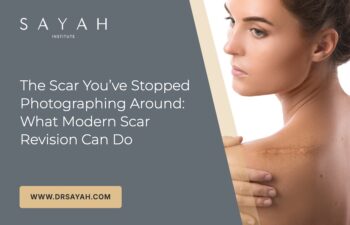
Some scars become invisible to everyone except the person who has one. A raised line across the collarbone that dictates which necklines get worn. A widened abdominal scar from a surgery fifteen years ago. A thickened burn scar that pulls when the arm extends. A facial scar from a childhood accident that still determines which side faces the camera.
Scar revision occupies an unusual place in plastic surgery. It is not about changing how someone looks so much as removing something that keeps interrupting how they live. Dr. David Sayah, a board-certified plastic surgeon and Fellow of the American College of Surgeons with over 26 years of experience, brings a particular background to this work: his research has focused specifically on wound healing and scar formation, which is the underlying biology every revision depends on.
Why Some Scars Heal Beautifully and Others Don’t
Two patients can have identical incisions and dramatically different results. Understanding why explains what revision can and cannot change.
- Tension across the wound: Skin under tension heals with a wider, more prominent scar. This is why scars over joints and across the chest tend to be worst.
- Direction relative to skin tension lines: Incisions placed along natural tension lines heal inconspicuously. Those crossing them do not.
- Depth and tissue loss: A wound that destroyed underlying tissue leaves a depressed or adherent scar that no surface treatment will lift.
- Infection or delayed healing: Any disruption of the initial healing phase increases collagen disorganization and scar thickness.
- Individual healing biology: Genetics meaningfully influence collagen deposition. Some people form hypertrophic or keloid scars regardless of technique.
- Age at injury: Younger skin heals more aggressively, which paradoxically can mean thicker scars.
- Anatomic location: The chest, shoulders, and upper back are notoriously difficult; the eyelids and scalp are forgiving.
Scar revision works by addressing the mechanical and structural factors on that list. It cannot change a patient’s healing biology, which is why realistic expectations are built into any honest consultation.
The Categories of Scar, and What Each One Needs
Treatment depends entirely on what kind of scar is present, and these are genuinely different problems.
- Widened or stretched scars: A thin, flat scar that has spread. Excision and meticulous closure with tension relieved in deeper layers often produces a substantially narrower result.
- Hypertrophic scars: Raised, red, and firm but confined to the original wound. Often responsive to injection therapy, pressure, and silicone, with surgery reserved for cases that plateau.
- Keloid scars: Raised growth extending beyond the original wound boundary. These require careful planning, because excision alone has a high recurrence rate without adjunctive treatment.
- Contracture scars: Scars that tighten and restrict movement, common after burns. Release techniques, Z-plasty, and tissue rearrangement restore function as well as appearance.
- Depressed or atrophic scars: Scars that sit below the surrounding surface. Addressed with subcision, fat grafting, or dermal filling to restore volume beneath.
- Adherent scars: Scars bound down to underlying structures, which tether the skin and look worse with movement. Release of the deeper attachments is the key step.
- Discolored scars: Scars that healed flat but pigmented or persistently red. Often managed with laser and topical treatment rather than surgery.
Mistaking one type for another is the most common reason scar treatment fails. A depressed scar treated with injections to flatten it gets worse, not better.
Surgical Techniques Worth Knowing About
- Excision and layered closure: Removing the scar and closing in multiple layers so that deeper tissue carries the tension rather than the skin surface.
- Z-plasty and W-plasty: Geometric rearrangements that break a straight-line scar into an irregular pattern, which the eye reads as far less noticeable, and that lengthen contracted tissue.
- Serial excision: Staged removal across multiple procedures for large scars, allowing surrounding tissue to stretch between stages.
- Fat grafting: Transferring the patient’s own fat beneath a depressed or adherent scar restores contour and appears to improve scar tissue quality.
- Tissue expansion and flap reconstruction: For extensive scars where local tissue is insufficient, bringing in healthy adjacent tissue.
- Scar repositioning: Relocating a scar into a natural crease, hairline, or shadow where it becomes far less visible.
- Skin grafting: For large areas of scar contracture where coverage is needed after release.
The Non-Surgical Tools That Do Real Work
Not every scar needs an operation, and in many cases a combined approach outperforms surgery alone.
- Corticosteroid injection: Reduces the volume and firmness of hypertrophic and keloid scars, often over a series of treatments.
- Silicone sheeting and gel: Well-supported for reducing scar thickness and redness when used consistently over months.
- Pressure therapy: Particularly valuable for burn scars and in keloid-prone patients.
- Laser treatment: Vascular lasers address persistent redness; fractional resurfacing improves texture and can soften scar collagen.
- Microneedling and resurfacing: Useful for shallow textural irregularity and discoloration.
- Massage and early intervention: Scars remodel for a year or more, and consistent attention during that window influences the final result.
Timing matters here. A scar less than a year old is still actively remodeling, and it will often improve substantially on its own. Operating too early can mean revising a scar that was going to look better anyway. Our practice generally recommends allowing a scar to mature before surgical revision, while beginning non-surgical measures early.
What Revision Realistically Achieves
This is the conversation that matters most, and it should happen before anything is scheduled.
Scar revision trades an existing scar for a different one. The goal is a scar that is thinner, flatter, better positioned, less restrictive, or less visible — not no scar at all. For most patients that trade is clearly worthwhile, and the improvement can be substantial. For some, particularly keloid-prone patients, the honest answer is that non-surgical management offers a better risk profile than excision.
Patients who come in understanding this distinction tend to be happiest with their results, which is why our consultations spend real time on it.
Frequently Asked Questions
- How long should I wait after the original injury or surgery? Generally twelve months or more for surgical revision, since scars continue improving during that period. Non-surgical treatment can begin much earlier.
- Will insurance cover scar revision? Scars that restrict function, cause pain, or result from certain injuries may qualify. Purely cosmetic revision typically does not. Our team can help you understand where your case may fall.
- Can a keloid be removed permanently? Keloids have a significant recurrence rate after excision alone. Combining surgery with injection therapy, pressure, and in some cases radiation substantially improves outcomes.
- How many treatments will I need? Non-surgical protocols usually involve a series. Surgical revision is often a single procedure, though large scars may be staged.
- Does scar revision hurt? Smaller revisions are performed under local anesthesia with minimal discomfort. More extensive procedures use sedation or general anesthesia.
- Can facial scars be improved significantly? Facial tissue has excellent blood supply and numerous natural lines to hide scars within, which often makes facial revision among the more rewarding procedures.
Find Out What Your Scar Can Become
A scar that has shaped your wardrobe, your photographs, or your range of motion for years is worth an informed evaluation. The honest answer may be surgery, a non-surgical protocol, patience while the scar matures, or some combination — but you deserve to know which.
The Sayah Institute welcomes patients in Beverly Hills, Los Angeles, and from across the country and abroad, with virtual consultations and travel assistance available for patients coming from a distance. Contact our office through the website to arrange a consultation with Dr. Sayah.
Medically reviewed by David N. Sayah, MD, FACS on
Posted on behalf of
436 North Bedford Drive Suite 202
Beverly Hills, CA 90210
Phone: (310) 385-0000